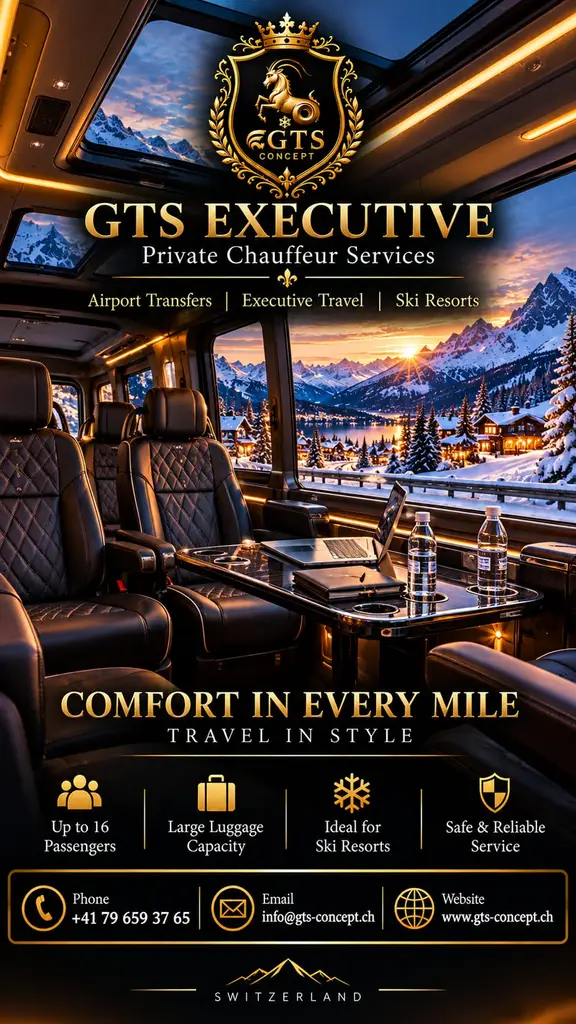

A missed connection at Geneva Airport, an overbooked resort transfer, or a driver who cannot accommodate ski equipment can alter an otherwise well-planned trip. Luxury transport is designed to remove those points of uncertainty, giving travelers a professionally coordinated vehicle, a qualified chauffeur, and a clear plan from arrival through departure.
For executives, families, and VIP guests traveling through Switzerland and across Europe, the standard is not simply a premium car. It is comfort, discretion, and reliability at every stage of the journey. That includes accurate pickup planning, appropriate vehicle selection, confirmed pricing, and the ability to adjust when flights, meetings, or hotel schedules change.
What Luxury Transport Should Deliver
A premium transfer begins well before the chauffeur arrives. The booking process should establish the essential details: flight or train information, passenger count, luggage requirements, destination, timing, and any special requests. When those details are managed carefully, the traveler is free to focus on a meeting, a family arrival, or the next part of the itinerary.
The visible elements matter. A well-presented Mercedes-Benz sedan or premium van creates the right setting for business travel, private airport arrivals, and formal events. Yet the quality of luxury transport is often decided by less visible details: a chauffeur who knows the pickup procedure, a coordinator who monitors the inbound flight, and a confirmed vehicle that is suitable for the route rather than merely available.
This distinction is especially relevant in Switzerland. A journey may involve an international airport, a city-center hotel, a financial district appointment, and an Alpine destination in the same itinerary. Road conditions, seasonal traffic, border crossings, and luggage demands can change significantly from one leg to the next.
The Right Vehicle Depends on the Journey
The most appropriate vehicle is not always the largest or most elaborate option. It depends on the number of passengers, the level of privacy required, luggage volume, route length, and whether the trip includes sporting equipment or multiple stops.
Executive sedans for focused travel
A Mercedes-Benz E-Class is well suited to individual travelers or small executive parties who value an efficient, polished airport or city transfer. For travelers who require additional rear-seat space and a more formal experience, an S-Class or electric EQS offers a higher level of refinement. These categories are particularly appropriate for corporate meetings, private dinners, hotel transfers, and long-distance travel where a quiet cabin supports preparation or rest.
Premium vans for families and groups
Families, delegations, and small groups often benefit more from a V-Class than from separate sedans. The additional cabin space supports a more comfortable shared journey and helps manage multiple suitcases, strollers, or carry-on items. For larger groups or transfers with substantial luggage, a Vito category may be the practical choice.
For ski travel, capacity should be discussed at the time of booking. A vehicle that comfortably carries four passengers on a city transfer may not be appropriate for four passengers with ski bags, winter luggage, and child seats. A professional coordinator will ask these questions early rather than leaving the decision to the day of travel.
Airport Transfers Require More Than a Pickup Time
Airport transportation is where service coordination has the clearest effect. A fixed pickup time is useful for departures, but arrivals require greater flexibility. Flight monitoring allows the chauffeur assignment to reflect the actual arrival time rather than the original schedule alone.
Meet-and-greet arrangements should also be clear. Travelers need to know where the chauffeur will meet them, how the driver can be identified, and what happens if baggage collection takes longer than expected. International arrivals can vary considerably, particularly at busy airports such as Geneva, Zurich, Milan Malpensa, Paris Charles de Gaulle, or Nice.
Waiting-time policies should be stated in advance. This protects both sides: the traveler understands what is included, while the transportation provider can maintain reliable scheduling for every booking. Clear communication is a mark of premium service, not an administrative detail.
For departures, luxury transport adds value through timing discipline. A chauffeur should arrive with sufficient margin for loading luggage and confirming the route, while the booking team should account for the airport, airline, terminal, time of day, and any seasonal congestion. The goal is not to arrive excessively early without reason. It is to arrive composed, prepared, and on time.
Cross-Border and Alpine Routes Need Local Judgment
A route between Geneva and Courchevel, Zurich and St. Moritz, or Milan and Monaco may appear straightforward on a map. In practice, it requires planning around mountain roads, weather, holiday traffic, border procedures, and the suitability of the selected vehicle.
During winter, the travel plan should allow for changing conditions. Travelers should confirm departure times carefully, especially on weekends when resort access roads are busiest. A premium chauffeur service is not a promise that traffic or snowfall will disappear. It is a commitment to prepare for those conditions, communicate clearly, and select a route and vehicle with the journey in mind.
Cross-border transfers also benefit from centralized coordination. A traveler should not have to manage separate providers for an airport arrival in Switzerland, a meeting in northern Italy, and a hotel stay on the French Riviera. Through a vetted network of licensed and insured transportation partners, GTS Executive Chauffeur Services can coordinate these journeys with a consistent booking standard across major European destinations.
When Hourly Chauffeur Hire Is the Better Choice
A point-to-point transfer is ideal when the schedule is simple: airport to hotel, hotel to meeting, or city to city. Hourly chauffeur hire is often better when the itinerary has several stops or may change during the day.
This option is valuable for executives attending consecutive meetings, guests visiting properties, families shopping or sightseeing, and event planners coordinating arrivals across multiple venues. The vehicle remains available according to the agreed service period, allowing the schedule to develop without repeated transfer bookings.
There is a trade-off. Hourly service offers flexibility, but it should be reserved for days that genuinely require it. For a direct journey with a clear destination, a fixed-price transfer is generally the more efficient arrangement. The right choice comes from an honest view of the itinerary, not from selecting the most extensive service by default.
Privacy Is an Operational Standard
For many travelers, discretion is not a luxury extra. It is a basic requirement. Financial professionals, executives, public figures, and private families expect a calm, confidential environment from the moment they are collected.
That expectation extends beyond conversation inside the vehicle. It includes appropriate chauffeur conduct, restrained communication, secure handling of itinerary information, and a professional approach to hotels, private residences, and event venues. A chauffeur should be attentive without becoming intrusive.
Vehicle presentation also contributes to privacy. Tinted rear windows where permitted, an immaculate cabin, and space to work or rest create a setting that feels controlled and comfortable. For longer journeys, practical details such as drinking water, onboard coffee service when arranged, charging access, and climate control can make a material difference.
How to Book With Confidence
The strongest bookings are made with enough information to match the service to the journey. Share flight details, the exact number of passengers, luggage estimates, preferred vehicle category, child-seat needs, and any mobility considerations. If the itinerary includes several stops or an international border, provide the full route rather than only the first pickup and final destination.
Advance reservations are recommended for peak travel periods, major events, holiday weekends, and ski season. Last-minute requests can often be accommodated, but availability in a preferred vehicle category may be more limited. Confirmed pricing before travel is equally valuable, particularly for airport and intercity transfers where travelers want clarity before committing.
A professional booking platform should remain accessible when plans change. Online requests and WhatsApp communication give international travelers a practical way to confirm details across time zones, while 24/7 coordination provides reassurance for early departures and late arrivals.
The best luxury transport does not demand attention during the trip. It earns confidence before the vehicle arrives, then carries the itinerary forward with quiet precision.